Halifax County, Virginia
Known as "Rosebank", "Hoveloke", "Clarkton" and now "Ardross".

A number of great plantations with their beautiful ante-bellum plantation homes were situated along the Staunton River in the last century. Some of them have gone with the passing of time, some are deserted and empty, and some still stand as historic examples of gracious living in a bygone era.
One of the handsomest of the old mansion-houses in this area is Clarkton, plantation home of the Clark family, on the crest of a ridge on the Halifax side of the river five miles southeast of Brookneal.
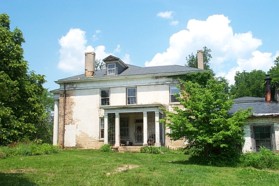 Originally the property was owned by Thomas Yuille. In his will dated April 24, 1792, he willed his son Thomas Yuille, Jr. his manor house called "Rosebank", with life rent for his wife, Sarah.
In 1841 the manor house and over 2000 acres came into the hands of the Clark family in a conveyance from Alexander Yuille to Charles Clark for the amount of $25,000.00. It has been stated that this high amount indicates that a "building of some dignity and size must have been on the property." It is not known whether the enlarged house was completed by the year of 1845, the year sometimes given as the date for the house.
Charles Clark hired Howard Cosby the architect responsible for so many fine Halifax buildings of the era. Cosby's distinguishing mark of etching lines in the stucco, imitating cut stone, is still evident in parts of the building. Clark renamed his estate "Hoveloak."
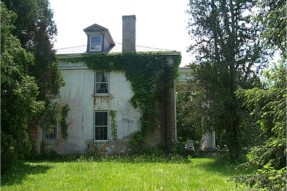 From information contained in an old leather-bound account book at Clarkton, it was learned that Colonel Jonathan Clark, squire of Old Chester, near Randolph on the Halifax side of the river, willed that a river plantation be bought for Charles Adolphus, youngest of his second set of children.
Charles Clark was educated at the University of Virginia and was considered a brilliant student. He was an ardent reader of the classics and a close observer of the opinions of the learned men of his time. While still very young, he contracted a respiratory ailment, which caused him to spend winters in a warm climate of the south and the West Indies.
He married Eliza Ann Spraggins, daughter of Capt. Thomas Lanier Spraggins of Halifax County, an officer of the War of 1812 and a relative of Sidney Lanier, the poet.

|
|
Squire Tom, as he was known, managed his plantation well. To his 5,600 acre estate, he added land on both sides of the Staunton River, and his nearly 6,000 acre plantation became one of the largest bright leaf tobacco farms in Halifax County. Tall corn grew in its river lowlands, cattle fattened on its grassy slopes and sheep grazed on the meadow land.
|
Tom Clark died in 1919, once more leaving a widow to run the plantation. Grace Clark lived for a number of years afterwards, and was very active
|
A daughter, Miss Elise Clark, studied art and shared a studio in Washington DC. Returning to Clarkton, she taught puppet-making to the children of the community. Under her direction, they built stage settings and produced puppet shows in the area. The other daughter, Anita Clark married a Mr. White and eventually returned with him to her old home. Through the church and community work, the Clarks gave the neighboring rural farm families opportunities for recreation and advancement they might never have had without their leadership.
When diesel locomotives replaced steam on the railroads, the water tank at Clarkton station was dismantled and in the 1990s the station itself was taken down and recycled to enlarge a neighboring mobile home. The post office and mail route were transferred to Nathalie, several miles away, and the store was abandoned. Now a visitor to the once thriving village by the tracks hears only the hum of the bees from the hives near the church or the tinkle of a cowbell out in the river pasture land.
Having land on both sides of the river, Clarkton Plantation bears at least one resemblance to Samuel Pannill's Green Hill estate, the Stanton River flows through, not by, the plantation. In the great flood of August, 1940, the river rose to a depth of six feet in the Clarkton station, half a mile away.
Anita Clark White, the last of the Clarks, died in 1970. In order to finance the scholarships set up in her will, the vast estate was divided into 20 parcels and sold at auction, setting a record for real estate transactions in the county. The manor house, with 100 acres was purchased by Mr. and Mrs. Vern Holman of Portsmouth, Va.. In 1984 this property was purchased from the Holmans by Mr. and Mrs. Reid F. Ross as their primary residence. The estate has been known by several names, it is now called by the Gaelic name ARDROSS, or high promontory. Mr. Clark never called it Clarkton.
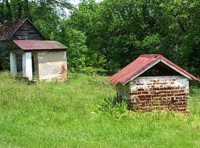
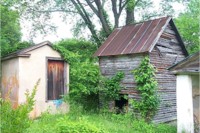
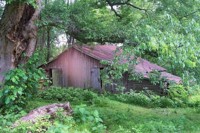
The manor house has many dependencies including the old kitchen, dairy, icehouse, stable, carriage house, smoke house, well house, and one of the only two known ash houses still standing in the county. The other is at Berryhill Plantation.
The plantation is unique in that Thomas Clark foresaw the great changes coming to the south and prepared for them.
It was near Clarkton that the section crew of Capt. H. C. Mustain was working on the railroad many years ago when they had visitors from outer space. (In those days railroad engineers, conductors and section foremen were called "captain".) The men were so intent on their work on the track that they did not see the silent thing that hovered above them, until a strange voice called,"Hello down there! Where are we?"
The startled section crew looked up to see a balloon drifting overhead. Now Capt. Mustain was no johnny-come-lately, and he wasn't about to be taken in by any smartalecs from outer space. So he shouted back, "It looks to me like you're up there in that little basket."
The balloon men persisted: "I mean where are we on the map? What railroad is that?"
Capt. Mustain replied that it was the L. & D., and the men in the balloon consulted their map, but on the map it was labeled the Norfolk & Western. So they tried again, "What river is that over there?" Told that it was the Staunton, they again consulted their map, but the river was designated the Roanoke. The balloon men gave up.
So Capt. Mustain won his bout with the men from outer space. He agreed with them that they couldn't be loster, and he and his men helped them haul down their balloon. They took the airmen on their motor car and brought them to Brookneal, where the flyboys made arrangements to have their balloon -and themselves-shipped back to Langley Field.
Sources include the late Kenneth Cook, a young historian, Mrs. Pocahontas Edmunds, Herman Ginther's book "Captain Staunton's River" with permission from the author, additional information from the present owners.
Back to Historic Sites