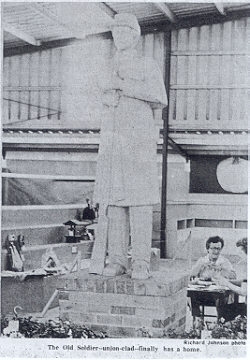
 Yank Soldier’s Statue Remains As Reminder of Monumental Error
The Halifax Gazette, South Boston, Va.
Thursday, August 28, 1952
Nearly overgrown by weeds, lying forlorn and nearly forgotten on the Fairgrounds lot here, a once-proud figure sprawls in disgrace, final monument to the bitterness that separated the North and the South less that a century ago.
People happening upon it today regard it wonderingly, and perhaps some young man may flex his muscles and try to move it from the place it has rested so many years. Children pause to laugh at the strange broad-brimmed cap and the long coat.
And although it is merely a figure carved from granite, older persons, still loyal Rebels, can almost picture the blue coat flung so proudly around the soldier.
For this is the figure of a Union soldier – a Union soldier who for a brief period topped the pedestal of the Confederate monument on the Courthouse lawn in Halifax.
Its moment of glory never came, for prior to the unveiling ceremonies set to reveal the stature and dedicate the monument to the memory of the War between the States discovered the mistake made by the sculptor, and sparked a mass meeting of county citizens, protesting its erection at the Courthouse.
Crowds poured into town when the Board of Supervisors met on June 27, 1910, turning the scheduled session into a mass meeting of protest.
Spokesmen for the Halifax County Camp of Confederate Veterans declared that there was “a great deal of feeling in the county against erecting the said figure”, and passed a resolution that it not be used.
The resolution commended the committee which had headed the move for a Confederate monument, and averred that “no criticism of them intended . . . but it would be a serious mistake to use said figure.”
According to Courthouse records, the figure was to be returned to the T. O. Sharpe Marble Company, which apparently had made the error. Since the books cover only minutes of Supervisors’ meeting, it is not clear what the next developments were.
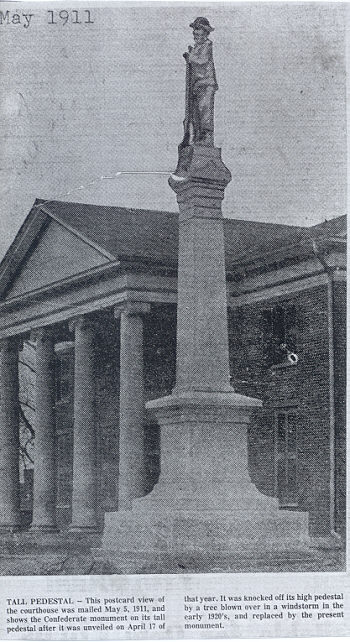 However, Mrs. J. E. Crawley, president of the United Daughters of the Confederacy, and Mrs. Aaron Vaughan, one of South Boston’s oldest residents, agree that it was replaced by the company that made it. Why the rejected statue of the Yankee soldier never was recovered by the sculptor is not known. For awhile it lay on the Courthouse lawn, near the monument it had lately adored; it was shifted from there when the new figure arrived, and for a number of years leaned against an old building on the Fairgrounds. When the building was torn down, the stature fell, and since has reposed inelegantly among the weeds surrounding its resting place.
After the stature had been rejected, the matter of an appropriate memorial came up again at the next meeting of the Board of Supervisors – on July18, 1910. At that time the design of a “Private Soldier, in short coat and slouch hat" was approved, and the order sent off. Cost of the figure was listed as “$200 and freight from the quarry to Houston.”
When the substitute statue had been erected, special unveiling ceremonies were held in Halifax, and staged by the South Boston Order of Red Men. Exactly how long after the original figure was rejected the second on was dedicated, cannot be established definitely.
But the erection of the statue of a Confederate Private was not to be the final step in Halifax County’s attempt to commemorate the War between the States, for several years later a bad windstorm uprooted a tree near the monument, felling it against the figure and knocking it to the ground.
Until late 1937 the monument stood without the figure. A delegation of UDC members, headed by Mrs. Berryman Green, who was president at that time, appealed to the Supervisors for an appropriation to replace the statue at the October, 1936 meeting. The specifications were approved in April 1937, and the stature was erected later that year.
Mystery and speculations still surround the reasons for the mistake made in the original statue. Perhaps it was someone’s idea of a joke – or could it have been that the sculptor did not realize that the model from which he carved his statue was a soldier with the wrong Army?
The answer, perhaps, lies forever buried, forgotten like the neglected Yankee soldier, last reminder of the ferocity of a war between brothers.
Friday, November 29, 1996
|
From An Old Confederate
Dear Bill: I ‘spose you’ve heard the news, Or else some body’s told yer About the celebration –and, The great big Yankee soldier? The ordered a Confederate But somehow mad a muss, The folks was out o’ Johnny Rebs And sent this Yankee cuss. He come marked with a big U. S., And that’s what raised the row, So they scratched the U and put a C He’s reconstructed now. I fit the Yanks all through the war And tried to do my part, And when at last they licked us I well nigh broke my heart. It’s over now, since many a year, And “North and South are one,” But I’ll want to fight fust time I see That Yankee and his gun. I hope I have forgive ‘em all, But I hates to see one round. The only use we’ve got for them Is to put ‘em under ground. But they’re going to make the best of it, And’ll have a big “To do,” They’ll all join hands and march and sing “A Yankee dude’ll do.” Well, Bill, goodbye – you may be there But for me, no thank’ ye, I aint a-going to help unveil No blooming granite Yankee! Houston, Va., (Halifax C. H.) Thursday, June 23, 1910 |
Beth Robertson
Almost a half century after the old men and boys marched out of town to join the out-numbered Confederate regulars fighting Union cavalry for Staunton River Bridge, the unthinkable happened.
A Yankee soldier arrived at Courthouse Square to claim the singular place of honor.
It was hell’s a’ poppin’ War all over again in old Houston town. It was … blasphemy.
The monument committee offered to resign, Confederate veterans wrote letters and poems to the newspaper, and editorials called for courtesy but resolute action in the summer of 1910.
All in all, controversy – laced with an ample dose of Confederate wit – prevailed.
Never, cried the populace, would a well-dressed Yankee soldier with U. S. stamped on his belt stand atop the courthouse pedestal for all the world to see.
The granite Vermonter had to go.
News accounts suggest that the Yankee soldier had arrived at the courthouse and had been seen by passing ladies and gentlemen prior to the planned unveiling ceremony. And, apparently, word of the “Yankee’s” invasion spread like wildfire throughout the country.
In two June 1910 editions of The Record-Advertiser, the statue controversy dominated the front page.
In one account, Judge Barksdale, no doubt the same William Randolph Barksdale who as a 15-year-old-student of the John Powell Academy took part in the Staunton River Bridge battle, was among those questioning the “U. S.” on the granite soldier’s belt.
A Dr. Melvin also made remarks criticizing the statue. “He wanted a statue with some expression and ‘determination in its looks and was unalterably opposed to using this one now and forever,’” reported the newspaper.
Other remarks carried in the June 30th edition included the following:
“Mr. Henry Edmunds made some most appropriate and well-timed remarks in showing how strongly the people were opposed to the so-called ‘Yankee’ figure.”
“Mr. E. T. Epps made it plain that he wore a belt with ‘C. S. A.’ on it.”
“Col Henry Easley, of the committee read a number of letters in regard to the statue for the monument, all of which went to show that a stock figure had not been put off on them, but that it was just what was ordered with the exception of the U. S.”
“The figure which it is proposed to erect on the Court House square can not be claimed by any well informed person to be that of a Confederate soldier,” wrote Paul D. Womack in June of 1910. His letter appeared on the Record-Advertiser’s front page.
Although Womack said it could be true a Confederate soldier wore a cap at the beginning of the war, or even wore similar garments, he pointed out there “is an accepted style for the Confederate soldier in all paintings and statuary of the war times and another equally pronounced type of the northern soldier.”
And Womack saw no reason to accept the Yankee stature, in spite of the costs.
He did not want it erected on the public square “to mock our heroes who wore the ‘grey’. I also wish to say that a well executed figure of the Southern type would be much more artistic and would inspire in our Southern youth a much holier reverence for our heroes and a greater devotion to right and manhood.
“As the son and grandson of Confederate soldiers, I call on all who honor the ‘men of the grey’, to protest against the unveiling of this stature, and as a citizen of Halifax County I call on the Honorable Board of Supervisors, as wardens of the Court square to prevent the erection of the said statue,” wrote Womack.
In the face of adamant opposition, Col. Easley offered a motion allowing the monument committee to resign and turn the work over to the Board of Supervisors, but was prevailed upon by Messrs. Lawson, Bouldin, Adams and others, to continue their work.
Prior to the public meeting called by the monument committee , a published notice, dated June 20, 1910, announced $193.50 had been contributed to the Confederate monument cause.
“Thanks for your promptness. Our Committee, hearing of dissatisfaction with the figure, have called a meeting of the people, women included, to meet us at Houston, Monday, the 27th, at 10 o’clock at which time the Supervisors will also be present. If the contributors do not want this figure, then let’s provide for another. Yours truly, Henry Easley, Treas.,” the front page announcement closed.
The rest is history.
A new Confederate soldier was ordered and stands today on the Halifax County Courthouse green.
The well-dressed Yankee was apparently unceremoniously discarded, which is another story.
Master of all he surveys and center stage at least once a year during the Halifax County Fair, does the Yankee soldier survive?
E. B. Wilkins’ family lore says, yes.
There in the great Exhibit Hall the old Yankee’s severed head rests serenely upon his shoulders, its non-surgical condition hardly noticeable. His pitted and smashed nose reportedly a casualty of youthful high spirits during his Fair residency in South Boston.
He wears a cap - a subject of 1910 controversy – and there’s a telltale “C. S.” engraved on a belt, which recalls one of the 1910 poems: “They actually had to impudence To Change my U to C –“
Rescued from a ditch near the courthouse by the late W. W. Wilkins, Sr., according to Mrs. E. B. Wilkins, the senior Wilkins “asked for and was given the soldier.”
He took the stature to the old fairgrounds in South Boston where it resided for years, recalled Mrs. Wilkins.
There it survived a fire and “some hard licks from children” before moving to its current home in the exhibition hall at the new fairgrounds.
“Buck (E. B. Wilkins) said he was going to give that poor old soldier a resting place when we moved here,” added Mrs. Wilkins.
Eighty-six years after his arrival at Halifax Courthouse, does the “reconstructed” Yankee survive, a lone and beloved sentinel in a sear of Confederates unaware of what once was?
A second granite soldier, found on “the old Poindexter” property off Main Street in Halifax, now stands guard at the Sam and Marianne Golightly residence.
The statue was found on property her grandfather, H. H. Shapard, bought, explained Marianne Golightly.
She retrieved the statue when she and her husband moved here in 1977.
The weathered Shapard statue bears no telltale initials, neither U. S nor C. S. A., which provoked 1910 controversy. And the soldier’s hat appears to have been the wide brim variety, although broken now, mirroring the one now worn by the Confederated statue at Halifax Courthouse.
Golightly has no other information on the granite soldier. However, she vaguely recalls hearing a story of the courthouse statue falling, and wonders if the stature could have been part of a replacement procession.
That story, at least for now, appears lost in time.
(Please roll the r’s in reading)
|
To Q. Stone Esq., Vermont, Dear Q: I’ve come down South to fill A very high position, And represent the Johnny Rebs We sent into perdition. I came down in a great big box And guess I’m still in one; These folks are raising Cain about What their committee’s done. These Southerners have got no sense And can’t tell chalk from cheese, Their ragged old Confederates never Had good clothes likes these! They ought to be tarnation proud To have a chap like me A standing on their pedestal For all the world to see. They actually had the impudence To change my U to C – I wonder if they thought ‘twould make A Johnny Reb of me? I hear some dreadful threats each day And rude insinuation – If I don’t lose my head, I fear I’ll lose my situation. …’would make a splendid joke To fool the folks at Houston, But I’m homesick, and I guess the South Don’t suit my constitution. They criticize my face and form And call my foot a ham. As a Union man I fill the bill, As a Johnny – I’m a sham. |