Halifax County, Virginia
Pannill's Bridge |
|
|
Few Southside Virginia residents are aware that a century and a half ago one of the main roads leading into Halifax County crossed the formidable Staunton River on a bridge at the lower end of Long Island. At the time, this was the only non-ferry means of entering the county from the north. “Pannill’s Bridge” was an integral part of Samuel Pannill's master plan for making Campbell County's Green Hill plantation a commercial center of Southside Virginia. Pannill owned large tracts of land on both sides of the Staunton River, as well as a grist mill, a store and shops at Green Hill. To move his tobacco and other agricultural products to market, Pannill enthusiastically joined those promoting river and canal transportation in Southside Virginia and North Carolina.
It was only a matter of time until, in the mid 1820's, he became Superintendent of the
Roanoke Navigation Company. Immediately he set about the business of making the
Staunton navigable to batteau traffic Buoyed by his success with the construction of channels, sluices and wing dams in the river he decided to enhance his Green Hill base by embarking on another impressive project - the construction of a bridge across the Staunton. The bridge would replace the ferry operation which had been serving the community at this location for over 70 years. Joseph Echols, the previous owner of the Halifax County property, had initiated ferry service here in the 1750's. The construction of this six span bridge, about 35 years after the first covered bridge was erected in America, further reveals Pannill's ambitious nature. Although details of construction have yet to be verified it is likely that the bridge was of the Town or lattice type, the design most commonly utilized in this part of the country during this period. Completed in the 1830’s and operated as a toll bridge, the new facility provided Pannill with an additional substantial source of income. It also improved his capability to manage his tobacco operations on both sides of the river. For the next 25 years a number of Halifax County roads converged on Green Hill or "Pannills" as the bridge offered the most convenient passage to cities such as Lynchburg and Charlottesville. The bridge was one of two eyed
by General R. E. Lee in April of 1865 as the remains of his once great
army retreated westward from Petersburg. To achieve a linkup with General Johnston, then operating in North Carolina, Lee
hoped to cross the
Staunton at "Pannills" and "Wards" bridges, the latter
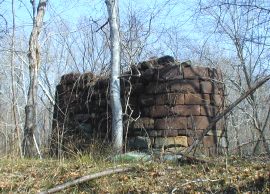
being twenty some miles upstream at Mansion. Pannill did not witness the destruction of the bridge, the disintegration of his dream empire nor the defeat of the Southern Armies. He died in September 1861 at Green Hill (see Pannill's Obituary). In his January 26, 1859 Will he left the bulk of his Green Hill estate, including the bridge, to his unmarried son John. His other son David was given rights to that part of the property in Halifax County until his death, then it reverted back to John. All of Pannills planning came to no avail however - the loss of the bridge, defeat in the war and, most importantly, his personal absence all factored into the rapid demise of the Green Hill community. In September of 1871, the Green Hill property was sold at auction to raise funds for the settlement of numerous debts. Portions of the stone piers and the ramped abutment are all that remain of the first covered bridge in Halifax County. The "Rock Barn" and other evidence of a 2100-acre presence in the county, known to some hopeful descendents of the Pannill family as the "Promised Land", are all gone. | |
|
Photos by Don Barnes. They were taken in Halifax County and show two of the three remaining bridge piers from the original six span bridge. The best way to see them is to float down the river. They are located about 2-1/2 miles down river from the boat landing at Long Island.
More information about Pannill, the bridge and other historical sites on the Staunton
River can be obtained
from the book "Captain Staunton's River" by Herman
Ginther.
Last updated on January 13, 2009
, |
 Little remains these days in
northwestern Halifax County to mark the legacy of Samuel Pannill of Green
Hill - a dirt road leading south, a small stone arch bridge over a stream,
a long earthen ramp, a tall bridge pier.
Little remains these days in
northwestern Halifax County to mark the legacy of Samuel Pannill of Green
Hill - a dirt road leading south, a small stone arch bridge over a stream,
a long earthen ramp, a tall bridge pier. 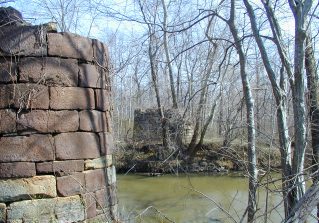 between Long Island and Brookneal.
Below Brookneal the Staunton was comparatively flat and river commerce
relatively simple. Thus he was able to directly transport his tobacco and
other merchandise down river as far as the falls of the Roanoke in Weldon,
NC. At this Lower Roanoke River "port" larger vessels capable of reaching
seaports on the Atlantic were available.
between Long Island and Brookneal.
Below Brookneal the Staunton was comparatively flat and river commerce
relatively simple. Thus he was able to directly transport his tobacco and
other merchandise down river as far as the falls of the Roanoke in Weldon,
NC. At this Lower Roanoke River "port" larger vessels capable of reaching
seaports on the Atlantic were available. 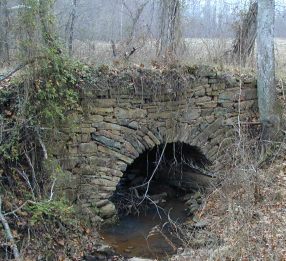 Unfortunately for Lee, the
only Confederate troops to cross the river bridge and the small stone
bridge on its approach (shown at the left) were those veterans of the
Army of Northern Virginia sadly walking in the direction of home after their
surrender at Appomattox. However, not all were afforded the benefit of
making a crossing on the bridge. Rather, the bridge
was burned by Confederates who had, to this point, managed to evade Grant's forces.
Many years later D.
M. Grabill, a trooper in the 18th Virginia Cavalry, described his part in
this action in a letter to the
Unfortunately for Lee, the
only Confederate troops to cross the river bridge and the small stone
bridge on its approach (shown at the left) were those veterans of the
Army of Northern Virginia sadly walking in the direction of home after their
surrender at Appomattox. However, not all were afforded the benefit of
making a crossing on the bridge. Rather, the bridge
was burned by Confederates who had, to this point, managed to evade Grant's forces.
Many years later D.
M. Grabill, a trooper in the 18th Virginia Cavalry, described his part in
this action in a letter to the
Two ancient stone mileposts at McKendree Church
Back to Staunton River Tour